

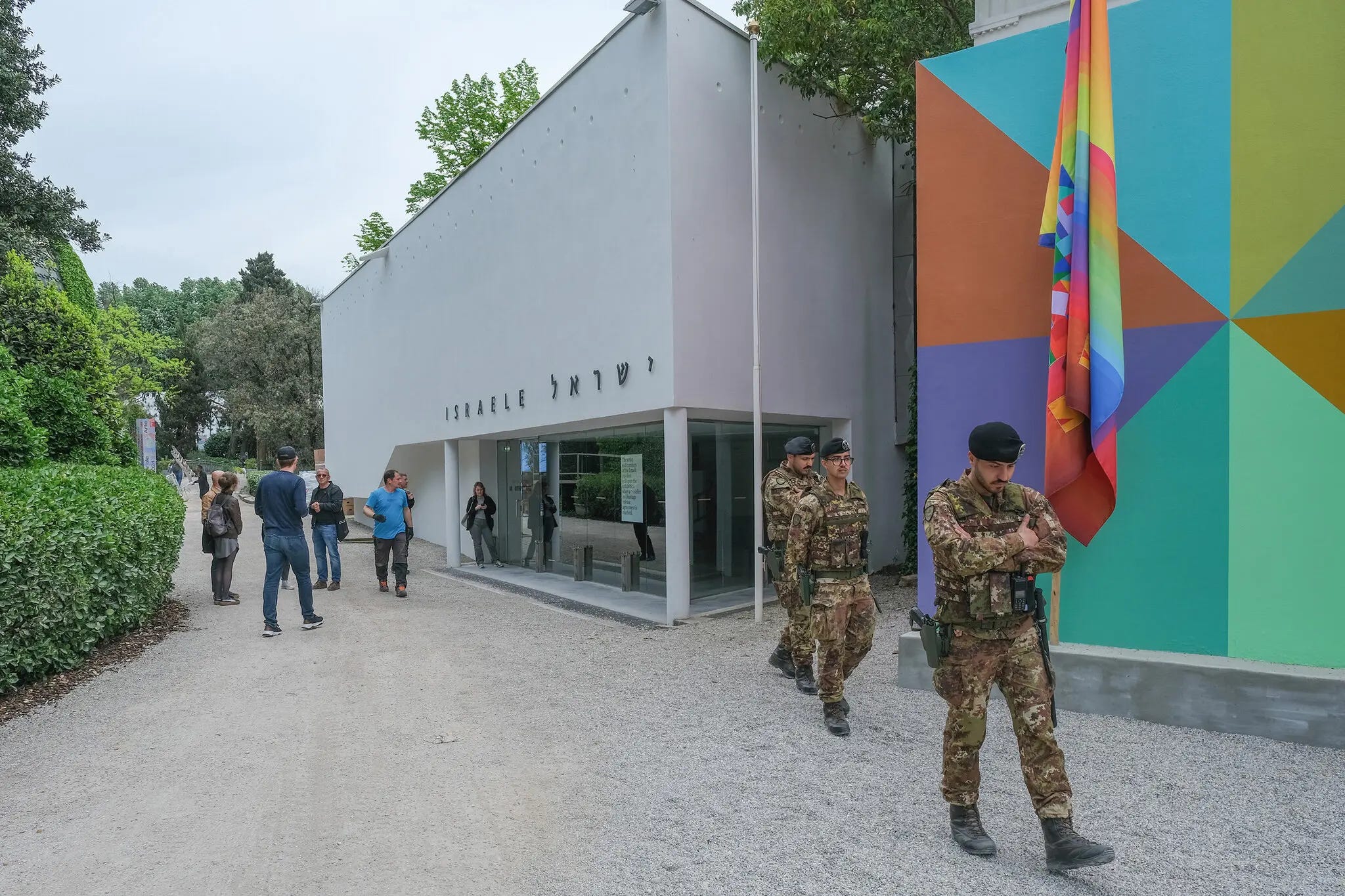
The prize jury for this year’s Venice Biennale resigned on Thursday — just nine days before the show’s opening — after a furor over its decision to exclude artists from countries accused of crimes against humanity from receiving awards.
In a brief statement posted to the art website e-flux, the five-person jury said simply that it had resigned “in acknowledgment” of its April 23 announcement that it would not give awards to artists from countries whose leaders were being investigated by the International Criminal Court.
The jury did not mention any countries by name in either announcement, but the International Criminal Court has issued an arrest warrant for Prime Minister Benjamin Netanyahu and his former defense minister, Yoav Gallant, on accusations of war crimes for Israel’s actions in Gaza.
The court has also issued an arrest warrant for President Vladimir V. Putin of Russia on accusations of war crimes in Ukraine, but the uproar over the ban had centered mostly on Israel.
On Sunday, Israel’s foreign ministry said in a statement on X that excluding Israeli artists had “transformed the Biennale from an open artistic space of free, boundless ideas into a spectacle of false, anti-Israeli political indoctrination.”
Want to stay updated on what’s happening in Israel and Russia? Sign up for Your Places: Global Update, and we’ll send our latest coverage to your inbox.
Belu-Simion Fainaru, a sculptor who is representing Israel this year, said earlier this week that he had consulted lawyers about the jury’s ban. On Wednesday, Italy’s culture minister called Fainaru to express his support for the Israeli artist, according to a news release.
Jury members did not immediately respond to requests for comment on Thursday, but a Biennale spokeswoman acknowledged their resignations in a brief statement.
Fainaru, 66, said in an interview that he was happy that the jury had stepped down. “Their decision discriminated against me on a racial basis,” he said.
“I’m an artist and have equal rights, and I can’t be judged by belonging to a country or a race,” Fainaru added: “I should just be judged on the quality and message of my art.”
Fainaru said the jury’s initial decision had reminded him of actions taken against his father in Romania during World War II. At that time, Fainaru said, his father was barred from teaching at a university and then sent to a forced-labor camp for three years.
“I didn’t think that discrimination would happen to me,” Fainaru said.
Belu-Simion Fainaru, who is representing Israel at the Biennale, said he was happy that the jury had stepped down.
The Venice Biennale, the art world’s most important event, consists of a central group show and more than 100 smaller exhibitions hosted in national pavilions. The jury awards the prestigious Golden Lion to the best national presentation, and recognizes some artists from the main exhibition.
The panel that resigned was made up of five curators: Solange Oliveira Farkas of Brazil, Zoe Butt of Australia, Elvira Dyangani Ose of Spain, Marta Kuzma of the United States and Giovanna Zapperi of Italy. The team had been selected by the curator of the Biennale’s main show, Koyo Kouoh, who died suddenly last year and whose exhibition is being realized by her assistants.
The Biennale said in a news release on Thursday evening that this year it would let visitors vote for the best national pavilion and award prizes to artists from the main exhibition. The winners will be announced on Nov. 22, the Biennale’s final day, the news release added.
Since Israel’s military invaded Gaza after the October 2023 Hamas-led attack, Israel’s presence at the Biennale has stirred controversy. Hundreds of Biennale participants have signed petitions calling on the event’s organizers to exclude Israel. And at the last edition, in 2024, Israel’s representative, Ruth Patir, shuttered her show, saying that she would not open it until “a cease-fire and hostage release agreement” was in place.
Russia’s participation has brought discord, too.
After it launched its full-scale invasion of Ukraine in 2022, the artists and curator who were set to represent Russia at that year’s edition pulled out. Russia has not staged a presentation since then. This year, it is set to return with an exhibition featuring mostly non-Russian artists that will run only during the Biennale’s preview week, from May 5-8.
Fainaru, who was born in Romania during the authoritarian rule of Nicolae Ceausescu, has already appeared once at the Biennale, representing his native country at the 2019 edition. Since moving to Israel in the 1970s, he has become a major figure in the art world there. Last year he received the Israel Prize, the country’s highest cultural honor.
For the 2026 Biennale, Fainaru said he would exhibit “Rose of Nothingness,” an installation that will include a water dripper used to irrigate fields. Its water will pool on the floor, Fainaru said, in part representing the coming together of people from different communities.
“Art should be a place to speak with each other,” he said, “not a way to exclude.”
Stefano Mazzola/Getty Images