

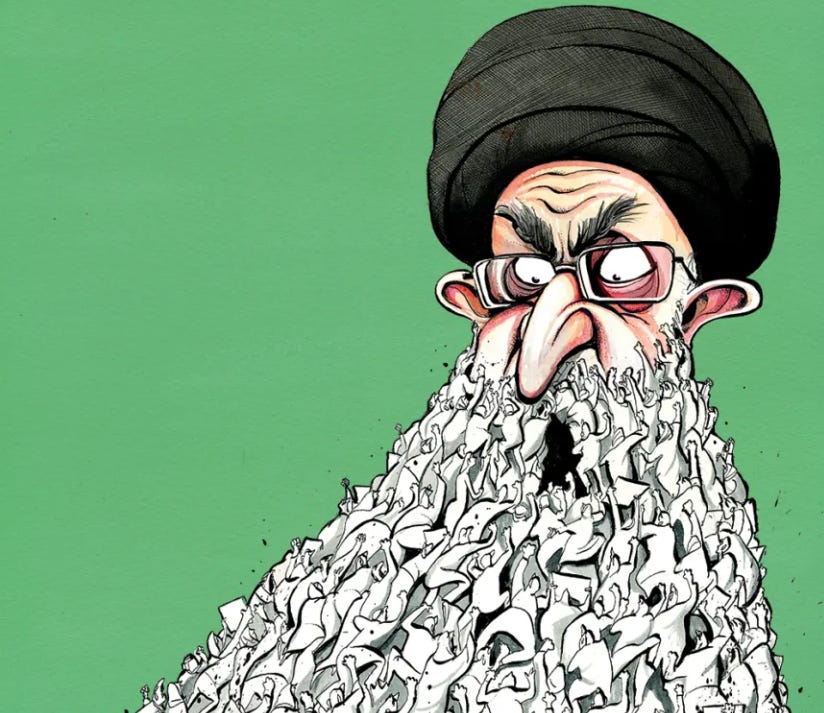
‘Help is on the way,’ promised Donald Trump to the people of Iran defying the Islamic Republic. In the same social media post, the US President, characteristically light on detail, also urged Iranian protestors to take over the institutions of the Islamic Republic (presumably by force) and to keep a note of the names and numbers of their oppressors for retribution’s sake. Whatever these words presage – be it air strikes on Iranian Revolutionary Guard Corps (IRGC) and Basij facilities, or cyberattacks on Iran’s intelligence agencies, to blind the regime as the regime has blinded protestors by shutting down the internet – it remains to be seen if such an intervention will tip the balance in favour of the regime, the protestors, or simply chaos.
Iran is a proud nation for whom independence from foreign interference is almost an article of faith, at least publicly. Yet Tehran relies on Chinese money, Russian hardware and Syrian, Afghan and Iraqi muscle to keep the show on the road. Likewise, today’s protestors seek and need US (and perhaps even Israeli) help in their battle against the Islamic Republic. A Trumpian endorsement and American bombs may well harm the nationalist credentials of those who have taken to the streets, but without the menacing pressure that only the US can provide (with Israeli capabilities hovering in the shadows), the protests are unlikely to withstand the onslaught of the regime.
There should be little doubt that even if their fall doesn’t come immediately, the rule of the Ayatollahs is broken beyond repair. Supreme Leader Khamenei and his henchmen have only exemplary violence left as the means to regain control. Despite the numbers of protestors being lower than previous outbursts of popular unrest in Iran (2009 and 2022/23 in particular), the death toll today far outstrips anything we have seen since the early, bloody days of the 1979 revolution when the Islamic Republic went on a killing spree.
Hospitals are filled with bodies, cemeteries in Tehran are overwhelmed with the sheer number of corpses, and there are stories of the authorities charging families exorbitant rates to release their dead loved ones from the morgue. Such reports give us an indication of just how brutal this latest round of repression has really been. Sensible estimates take the death count to well over 10,000 Iranian civilians, with many more to be executed as the regime’s judiciary fast-tracks its victims to the hangman.
This violence simply cannot sustain Ayatollah Khamenei indefinitely, no matter how united the Islamic Republic’s military and security forces might appear. Today we talk in terms of protestors and government forces, but how long will it be before we are speaking of a civil war, insurgents and ‘terrorists’? A feature of so much analysis of the Islamic Republic of Iran since 1979 has been an almost obsessive focus on two things: either predicting the coming revolution or proclaiming regime stability. What this troublingly narrow dichotomy fails to do is to allow space to consider other options: a coup, regime collapse, a civil war, something else.
The six years I spent on the Foreign Office’s Iran desk were frustrating for many reasons, but chief among them was the habit of senior mandarins to proclaim how ‘robust’ and how ‘together’ the Islamic Republic was as each successive round of protest erupted. ‘No chance of change there,’ they’d say confidently. ‘Just a bunch of schoolgirls,’ one senior diplomat said haughtily as brave Iranian women and men marched in the Women, Life, Freedom protests in 2022.
History has so far proven these mandarins right in absolute terms, but their unwillingness to see in Iran anything beyond revolution and survival and their refusal to engage with the myriad subtleties and complexities of the country mean that they are blind to what is really going on and where it might go. Of all the scenarios open to Iran today, perhaps the two least probable are a coherent popular revolution or regime stability ad infinitum. We didn’t see 1979 coming, and we will likely miss this one, too. Even, perhaps, if it comes courtesy of US bombs.
The protests might have begun in an electronics bazaar of Tehran, but their most violent expression has been in Iran’s western and southern provinces, home to Kurdish, Baloch, Ahwaz and Lur ethnic groups, mostly non-Shia who feel hard done by in a system in which they cannot win. The Baloch Liberation Army, Jaish al-Adl and Sepah-e Meli-e Kurdistan are but some of the armed groups that have clashed with Iranian authorities since 28 December and who pose a significant threat both to the Islamic Republic and whatever follows it.
We should remember that the IRGC began life as a volunteer force whose primary duty was to put down Kurdish separatist movements that threatened early revolutionary gains. Likewise, Iranian hitmen spent the best part of two decades hunting down ethnic separatists and Kurdish dissidents across Europe, and since last spring there has been a steady trickle of violence in Iran’s Sistan-Balochistan province, with IRGC figures assassinated and sporadicacts of anti-regime violence.
Iran’s ethnic makeup is a fault line along which a country thrown into chaos could fracture, as we have seen in Iraq, Syria and Libya. ‘The price we could pay for freedom is a high one,’ an Iranian woman told me. ‘We don’t want to be Syria or Libya.’
More worrying for the Islamic Republic are credible reports that protestors in Isfahan, Tehran, Mashhad and Tabriz are doing what they can to lay their hands on weapons, further raising the spectre of civil war and armed insurrection as urban centres adopt the tactics of Kurds, Baloch and Lur fighters. One veteran of the fight against the Islamic Republic tells me that the biggest risk he sees today is not regime collapse or a revolution, but a civil war in which Iran breaks apart.
Karl Marx wrote in The Eighteenth Brumaire of Louis Bonaparte that ‘those who cannot represent themselves will be represented’. This risk hangs over these protests. A shapeless, leaderless movement is suited to evade government oppression, offering Iranian intelligence apparatus no clear targets. Yet without a charismatic leader who can reach across ethnic and sectarian divides, what hope is there for a coherent Iran after the fall of the Islamic Republic? Every successful revolution needs such a leader. In 1979, Khomeini’s unbending commitment to the overthrow of the Shah defined Iran’s revolution, even if he did not represent all of Iran’s revolutionaries. In a battle of wills, it was his that came out on top.
Today there is simply no one who can match the regime’s chilling brutality and will to survive, despite the surge in popularity for Crown Prince Reza Pahlavi, the eldest son of the last Shah, now living in exile in Mary-land. And it is this on which Khamenei is betting: I can kill more of your people than you have stomach for the fight. At some point, so the Khamenei logic runs, those conservative merchants of the bazaar who started this whole thing off will come crawling back to the regime begging for law and order to be restored as the country burns and their shops remain shut.
In the lead-up to Iran’s 1905 Constitutional Revolution, there was a dialogue among those opposed to the Qajar monarchy about the future state they wanted to build. Iranian thinkers talked grandly, if misguidedly, of ‘law’ and a ‘constitution’, and even adopted one, sidelining the Qajar monarchy along the way.
Likewise, in the lead-up to 1979, Ayatollah Khomeini was but one voice among many articulating a vision for a post–Pahlavi Iran. These were times of intellectual ferment and underground cells, of ideas and political theory. Today, despite diaspora calls for democracy and a vague return to a pre-Islamic Republic Iran, there is little in the way of ideology that can make sense of the anger and rage.
Gone are the days of the Green Movement in 2009 when the calls for democratic accountability and reform implicitly accepted the legitimacy of the Islamic Republic. Now, all that is sought is a violent end to the regime. ‘Only blood can wash away blood,’ is a Persian proverb that is being repeated by mourners and protestors, as sure a signal as any that this fight has entered the realm of revenge and rage.
And yet the regime still stands. There are few discernible cracks. Khamenei’s circle of advisers and acolytes still back him to restore order at the barrel of a gun and the noose of a rope. In the early days of this protest, it was hoped that figures from the army (a traditionally less ideological institution that is often seen to be in competition with the IRGC) might cross the barricades, but they were swift to proclaim their support for the regime. Likewise, more ‘reform-minded’ politicians, Foreign Minister Abbas Araghchi and President Masoud Pezeshkian have all swept in behind Khamenei. Too many people in positions of power have too much to lose from a revolution, civil war or chaos.
It is into this mess of ethnic grievance, sectarian tension and lack of opposition cohesion that Trump’s military action would enter, even if he did limit himself to bombing IRGC facilities. Should he arm separatist and opposition elements to continue taking the fight to the Islamic Republic, things could quickly spiral out of control. American military action must be grounded in a credible plan for a post-Islamic Republic Iran that goes beyond the headline-grabbing spectacle we saw in Venezuela. America’s Arab allies will be making a strong case for sensible planning in the White House, for the last thing the Middle East needs is another civil war that could destabilise Iraq, Syria, Lebanon and Afghanistan, creating a haven for ISIS, a flood of refugees into Europe and the deaths of countless more Iranians. Whether the Trump administration has the nous, not to mention the tenacity, required for such a task is another question.
Last week, in a little-known village in the western province of Ilam, the Islamic Republic was handing out bags of rice. It was a measure of help to an impoverished community intended to stave off the wave of uprisings that were beginning to move from the bazaars of Tehran into Iran’s marginalised provinces. Yet instead of taking the much-needed rice home to cook, the people publicly tore open the bags and destroyed the contents. Although it was a small incident in a forgotten village, rapidly eclipsed by the bloodshed on Iran’s streets and the prospect of US military intervention, it encapsulates the Islamic Republic today: a theocratic kleptocracy whose authority is damaged beyond repair and that perhaps waits only for the final blow.
Writer: Charlie Gammell