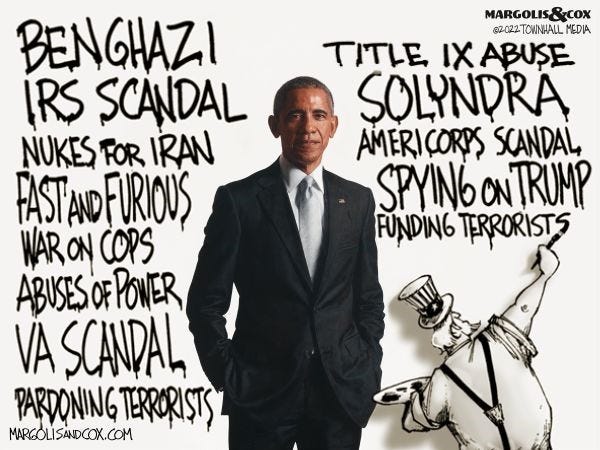
Obama wasn’t a peacemaker; he was brainwashed by the same people who poisoned Columbia University into hating America and supporting the IRGC, Palestine, and the Muslim Brotherhood, all funded by Qatar. He was a president who mistook his own narrative for reality, failed to understand the enemy, believed a check and a handshake could talk a revolutionary regime out of forty years of stated doctrine, and was willing to let a terrorist organization with American blood on its hands continue operating at full strength while he cashed in on the applause.
FULL ARTICLE
How the White House Buried America’s Biggest Terror Investigation
When Karl Marx famously declared that “religion is the opium of the people,” he didn’t necessarily get it wrong; he just hadn’t met Barack Obama. For eight years, the Obama administration systematically drugged the Western public with a comforting fairy tale: that radical Islam isn’t that radical, that the Ayatollahs in Tehran are merely “moderates,” our enemies just need a hug, and that if we sign a historic piece of paper, they will lay down their arms and join the family of nations. It was intellectual opium, distilled to perfection. But while Western voters were happily lulled to sleep by this rhetoric, one of the greatest geopolitical betrayals in modern history was unfolding behind the scenes.
This betrayal wasn’t just naive idealism; it was criminal abandonment by a megalomaniac who published his own autobiography in his early thirties and wanted to be remembered as the president who saved the world, yet all he did was sacrifice American lives and safety to feed his grandiose narcissism.
Our story begins where you’d least expect it: deep in the wiretap rooms of a counter-narcotics unit tracking Colombian drug cartels. The DEA intercepted a phone call originating in South America between Colombian cocaine cartel members, but the federal agents listening through their headphones, trained to hear and translate Spanish, heard a completely different language; it was Arabic.
That single, anomalous phone call was just the first thread in something much bigger. Analysts flagged it and moved on, certain it was a fluke, a crossed wire, a mistake. It wasn’t. Another call surfaced, then another. Same accent, same cadence, buried within cartel networks that had no business speaking Arabic.
So they set up surveillance and followed the money trail, agents pulling one thread after another, patiently and quietly. At the end of that thread was something nobody in Washington was prepared to find: the largest, most sophisticated drug-and-terror network the world had ever seen, a billion-dollar drug-cash cartel, led back to a single name: Hezbollah, which had built and was operating the most sophisticated cocaine-and-terror cartel the world had ever seen, hiding in plain sight. The DEA had, for one brief window, the case to bring it all down.
A team of elite American agents had spent years tracing the money, building an airtight case, and tightening the noose around its neck. They had the names, the indictments, and, for a brief window, the green light to take it all down. It was a once-in-a-lifetime opportunity to dismantle the terror cartel responsible for the deaths of many Americans.
But then, the White House stepped in and cut the rope.
The Obama administration, supposedly committed to national security, grants absolute impunity to a terrorist organization with American blood on its hands. Grab a drink. We are about to look directly into the West Wing’s darkest blind spot, starting with the operation they desperately tried to bury. Handed Hezbollah’s multi-billion-dollar drug cartel diplomatic immunity, allowing it to flood the world with poison and blood.
Welcome to the insane, suppressed story of Operation Cassandra.
Cassandra
In Greek mythology, Cassandra was a Trojan princess cursed with a brutal gift: she could see the future with perfect clarity, yet no one would ever believe her. She watched the wooden horse roll through Troy’s gates and screamed the truth to a city that had already decided not to listen. In 2008, a group of DEA agents named their most important operation after her, though they didn’t realize how literally the curse would apply.
Hezbollah is a U.S.-designated Foreign Terrorist Organization, backed by Iran, and responsible for some of the deadliest attacks against Americans in modern history. The money that Project Cassandra was built to choke off was funding EFPs that tore through American armor and killed hundreds of U.S. soldiers in Iraq. The threat wasn’t confined to a battlefield overseas. In June 2017, federal agents arrested two Hezbollah operatives who had spent years casing targets inside the United States, including two New York airports, an FBI office, and U.S. military and law enforcement facilities in New York City, laying the groundwork for attacks on American soil.
This is what was at stake: a terror network with American blood already on its hands, actively building capacity for further attacks. In 2008, a small task force set out to do what no one had managed before: dismantle Hezbollah not through airstrikes or sanctions alone, but by targeting the one thing every terror network needs to survive. Money.
An Operation the Size of a War
To understand what it took to get this close to Hezbollah, you have to understand what the task force was actually running: a web of parallel operations spanning three continents, each feeding intelligence into the next.
In Paris, an entire European offshoot of the case, later known as Operation Cedar, began with almost nothing: a single phone number passed along by DEA agents working out of the American embassy in January 2015. French investigators traced it and uncovered a network that moved Hezbollah’s drug money through luxury goods, watches, jewelry, and high-end merchandise bought in bulk at Paris boutiques, shipped abroad, resold, and converted into clean cash that made its way back to Lebanon. It was money laundering dressed up as a shopping trip.
By the time Project Cassandra reached its peak, it had ceased to be an American investigation. It had become a coordinated, multinational operation spanning four continents, and for a brief window, it looked unstoppable. In the United States, over thirty federal agencies operated from a blacked-out facility in Virginia, coordinating wiretaps, informants, and financial forensics on a scale rarely seen outside wartime intelligence work.
The Mossad wasn’t a bystander in this story. It was an active operational partner from the earliest days, running joint counterterrorism-finance operations alongside DEA agents, sharing intelligence on a terror network sitting on Israel’s own northern border. The entire drug-and-terror network Cassandra spent eight years mapping traced back to one architect: Imad Mughniyah, Hezbollah’s chief of external security operations and one of the most wanted terrorists in the world, a man with a hand in the 1983 U.S. Embassy and Marine barracks bombings in Beirut that killed hundreds, years of hostage-takings, and the 1994 bombing of a Jewish community center in Buenos Aires that killed 85 people.
In February 2008, Mughniyah was killed in Damascus during a joint Mossad-CIA operation so precise it required special, direct approval from President George W. Bush: a small bomb smuggled into the headrest of his SUV and detonated by remote control the moment he sat down.
In Belgium, U.S. authorities picked up a chilling signal: Hezbollah wasn’t just fighting to keep its man out of American hands — it was preparing to kill to do so. Intelligence uncovered a plot to assassinate the prosecutors building the case against him and to kidnap a Belgian defense attaché in Beirut as leverage. It was a race against the clock — and Belgian and American authorities won. Before Hezbollah could act, the operative was spirited out of the country and delivered straight into U.S. custody.
Germany was where the real money moved. Roughly one million euros a week flowed through the European laundering network, and most of it passed through a single node: a courier based in Düsseldorf who, by several accounts, wasn’t just another operative — he was Hassan Nasrallah’s own nephew, quietly running one of Hezbollah’s most lucrative pipelines from inside Germany’s borders.
This wasn’t a drug case with a few foreign leads. It was, in effect, a multinational war footing against a single terrorist organization, the kind of coordinated global effort usually reserved for hunting a head of state or dismantling a nuclear program. Agencies that don’t normally share a parking lot were sharing raw intelligence. Governments that don’t usually agree on anything were, for a few years, rowing in the same direction.
The Order From Above
By 2011, the task force had everything it needed. Wiretaps spanning three continents. A paper trail leading directly to Hezbollah’s inner circle. Indictments drafted and ready to file. They had built, agent by agent, year by year, a case strong enough to gut the terror group’s entire financial machine in a single coordinated strike.
But something strange began to happen. Slowly, then all at once, the machinery of Washington turned against its own agents. Requests disappeared into silence, swallowed somewhere between one office and the next. Search warrants sat unsigned on desks, gathering dust while the clock ran out. Wiretap renewals expired before anyone could approve them — as if approval had simply stopped being anyone’s job. Extradition requests were shelved without explanation, filed away in a place no one seemed willing to name. And it wasn’t random. Someone, somewhere, had decided.
The Slow Kill: A Timeline of Betrayal
Killing Cassandra Operation didn’t happen overnight, nor did it happen with a single order. What you’re about to read is betrayal at its highest level: how Obama and his administration slowly strangled and buried this operation, one deniable decision at a time, until one day the patient was dead and nobody could pinpoint the exact moment it happened. Take a breath. Then follow the timeline.
In 2008, Project Cassandra launched. DEA agents begin mapping what will turn out to be the largest, most sophisticated terror-financing network they have ever encountered. Two years later, in May 2010, Obama’s chief counterterrorism adviser, John Brennan, stands in front of a Washington audience and calls Hezbollah “not purely a terrorist organization,” insisting instead that American policy should help strengthen its “moderate elements.”
Read it again. Hezbollah is the organization behind the 1983 bombing of the U.S. Embassy in Beirut, the same year it also leveled the Marine barracks, killing 241 American servicemen in their sleep, the deadliest single attack on U.S. Marines since Iwo Jima. It has kidnapped, tortured, and murdered American hostages by name. It has American blood on its hands that has never been allowed to dry.
In May 2010, John Brennan, the man Obama trusted to run his counterterrorism policy, stood before a Washington audience and called this organization “not purely a terrorist organization,” arguing that U.S. policy should instead work to strengthen its “moderate elements.” Internally, the message went even further: DEA officials would later acknowledge they were pressured to avoid even using the word “terrorist” when briefing partners on Hezbollah’s criminal networks, softening the label of an organization built on American corpses because the truth had become diplomatically inconvenient. It was the doctrine, stated in public, years before anyone outside the task force understood exactly what it would cost.
In October 2011, task force intelligence helped expose and foil an Iranian-backed plot to assassinate Saudi Arabia’s ambassador to the United States at a Washington, D.C., restaurant. It should have been a career-defining win for the agents involved.
Instead, the White House declines to publicly credit the DEA for its role. That same year, prosecutors indicted Hezbollah-linked operative Ayman Joumaa for smuggling 85 tons of cocaine into the United States and laundering more than $250 million of the $850 million in drug proceeds his network handled. The criminal indictment omits any mention of his ties to Hezbollah, charging him only with narcotics and money laundering offenses. The terror connection, which took years to prove, never became part of the legal case against him.
November 2012. Obama wins re-election. He will never face American voters again, and a deal with Iran becomes the signature project of his remaining years. Within weeks, according to task force veterans, opposition to Cassandra’s work turns systematic.
Early 2013. A new national security team takes over: John Brennan moves to lead the CIA, and John Kerry replaces Hillary Clinton at the State Department. In March 2013, Obama personally authorized a secret channel to Iran, sending a handpicked team to Muscat, Oman, to meet Iranian officials face-to-face, a channel kept hidden even from close allies, including Israel.
That same year, the Justice Department refused to indict Abdallah Safieddine, Hezbollah’s envoy to Tehran, on weapons-smuggling charges, even though task force agents had two eyewitnesses ready to testify that he attempted to buy 1,200 military assault rifles. A frustrated Jack Kelly, the DEA agent handling the Hezbollah cases, wrote in an email that year: “The FBI and other parts of the USG provide little or no assistance during our investigations.“
2013 to 2016. This is the slow strangulation. Search warrants sit unsigned for months. Wiretap renewals expire before they are approved. Extradition requests vanish into the State Department, which Kerry now runs. Task force agents are no longer invited to interagency meetings on transnational crime. Their reports on Hezbollah’s drug empire stop appearing in the president’s daily threat briefing. On paper, Hezbollah itself quietly disappears from the White House’s list of transnational criminal organizations, as if the threat had simply ceased to exist.
Read that timeline from start to finish, and one thing is undeniable: It was a series of specific, deliberate choices made by specific people at the exact moments when making them carried the least political cost. Every unsigned warrant was a choice. Every canceled briefing was a choice. Every eyewitness Washington chose not to put on the stand was a choice. And every one of those choices left a designated terrorist organization, with American blood already on its hands, free to keep building an empire that still stands today.
But why? Why would the Obama administration stop this? After years of patient, dangerous, meticulously built work, with a terrorist organization responsible for American deaths finally within reach of real consequences, who benefits from letting go? The answer isn’t a single villain. It’s a list of them, each with a different reason to want Cassandra dead.
The Poison Reached the Top
Barack Hussein Obama spent his formative years absorbing Edward Said’s framework of Western guilt and the belief that the West simply misunderstands its enemies. He and Rashid Khalidi, the scholar who would later hold Columbia’s Edward Said Chair, were close friends and regular dinner companions in Chicago for years. Obama himself said publicly that their conversations were “consistent reminders to me of my own blind spots and my own biases.” Said himself dined with Obama in 1998, a year before he published his own memoir, fittingly titled Out of Place.
Obama phoned Mohamed Morsi, Egypt’s Muslim Brotherhood president, to broker a Gaza ceasefire in 2012 and came away, according to the New York Times, “impressed” with Morsi’s “engineer’s precision,” despite Morsi’s own recorded remarks calling Jews “descendants of apes and pigs.” He invited Morsi to the White House. His administration went further still with CAIR, the Council on American-Islamic Relations, an organization named an unindicted co-conspirator in the 2007 Holy Land Foundation terrorism-financing trial. Ties were serious enough that the FBI formally cut off contact with the group. Despite that, CAIR representatives visited the Obama White House at least twenty times starting in 2009, and in 2011, his Justice Department declined to pursue renewed indictments against CAIR.
Barack Hussein Obama wanted to be remembered as the president who solved the Middle East. What he actually built was a deal that handed Iran everything and asked for a signature in return. In January 2016, his administration flew $1.7 billion in cash to Tehran, officially “settling” a decades-old arms dispute, with the delivery timed to land the same day Iran released American prisoners, a sequence the State Department later admitted was deliberately orchestrated for “leverage.”
The nuclear deal itself unfroze more than $100 billion in Iranian assets and included sunset clauses that allowed enrichment restrictions to expire within a decade: not eliminating the program, just delaying it. All the while, a federal task force with an airtight case against Hezbollah’s terror-financing empire watched its own government pull the plug, one denial at a time, so nothing would complicate the agreement that gave Iran everything and got nothing in return, thereby putting American lives at risk.
Obama wasn’t a peacemaker; he was brainwashed by the same people who poisoned Columbia University into hating America and supporting the IRGC, Palestine, and the Muslim Brotherhood, all funded by Qatar. He was a president who mistook his own narrative for reality, failed to understand the enemy, believed a check and a handshake could talk a revolutionary regime out of forty years of stated doctrine, and was willing to let a terrorist organization with American blood on its hands continue operating at full strength while he cashed in on the applause.
Every dollar Project Cassandra failed to seize was a dollar Hezbollah spent on the next EFP, the next assassination, or the next kidnapping used as leverage against an ally. That’s not a foreign policy disagreement. That’s a president who decided his own story mattered more than the lives it cost and called it statecraft.
The Head of The Snake and the love letters
Iran didn’t just want the Cassandra money to keep flowing. It played Obama like an instrument, and the paper trail is almost embarrassing to read.
Starting in June 2009, Obama did something no American president had ever done: he began writing personal, secret letters directly to Iran’s Supreme Leader, Ali Khamenei, not through Congress, not through public diplomacy, but through Swiss diplomatic channels and later a covert backchannel in Oman. There were at least four of these letters over five years, each one sent as Obama tried to build trust with a regime whose official chant remains “Death to America.”
While Obama was writing love letters to a man plotting to keep his terror network solvent, his own negotiators were meeting Iranian officials in secret hotel rooms in Oman starting in March 2013, months before the public knew any negotiation existed. When the talks finally became formal, even close U.S. allies who should have been in the room were kept in the dark about how far along the back channel was. Iran got a direct, secret line to the President of the United States. Israel got nothing. America’s own ally, the country Hezbollah’s cocaine money was literally arming attacks against, the country that helped build the Cassandra operation itself with intelligence and technology, wasn’t even informed.
Iran understood exactly what it was holding, because Obama had told them himself. In one of his final letters, sent in October 2014 as the nuclear deadline approached, Obama explicitly wrote that U.S. cooperation with Iran against ISIS depended on Iran reaching a nuclear deal by November 24. He wasn’t responding to Iranian pressure. He was handing Tehran a second bargaining chip for free, telling them exactly how badly Washington wanted both things at once. Iran didn’t have to fight for that leverage. Obama gave it to them in writing. And while all of this played out, Iran kept funding Hezbollah’s drug empire without missing a beat.
Here’s how the courtship ended, and it reads like a joke because it is one: Iran walked away with sanctions relief worth well over a hundred billion dollars, $1.7 billion in cash flown to Tehran, a nuclear program handed an expiration date instead of a grave, and a terror-financing investigation that died quietly so none of it would complicate the signing photo. The United States walked away with a signature, a handshake, and a president who spent five years mailing his hopes to a man whose regime’s official chant is still “Death to America.”
Obama didn’t just fail to get anything for what he gave away. He handed Tehran a second bargaining chip in writing, for free, in a letter, because he wanted to look like a peacemaker so badly he forgot he was supposed to be negotiating. Hezbollah never stopped running the largest drug cartel of its kind on earth through any of this. It just got eight years of American law enforcement conveniently looking the other way while it did. That’s not diplomacy. That’s a man who begged for a deal so badly that Iran didn’t even have to ask for anything. He gave it to them first and thanked them for taking it.
The Verse They Never Read
Long before “Prophet” Muhammad moved against the wealthy, fortified Jewish tribe of Banu Nadir in Medina, he had already formulated his battle plan. He looked at his enemies and saw a structural flaw that rendered their high walls useless. That insight was codified directly into the Quran, in Surah Al-Hashr: “You would think they were united, but their hearts are divided.“ The siege unfolded exactly as predicted. Banu Nadir’s promised reinforcements never came, and the tribe was expelled from Medina, stripped of its land and fortresses. By contrast, a Jewish tribe that fought instead of folding, Banu Qurayza, was besieged months later and met a far darker fate: the men were executed, the women and children enslaved.
This was the foundational doctrine of Islamic expansion: an enemy that seems formidable from a distance but is already defeated by internal betrayal and luxury. You don’t need to match their wealth or their weapons. You just need to exploit their weakness, empathy, and division, strike them piece by piece, and watch them collapse under the weight of their own divisions.
Fourteen centuries later, this remains the lens through which radical Islam views the modern West. When the Ayatollahs in Tehran or the strategists of the Muslim Brotherhood look across the Atlantic, they don’t see a terrifying superpower; they see the fulfillment of the prophecy of Medina. They see a progressive Western elite so consumed by identity politics, tribal factionalism, and civilizational self-loathing that they can no longer agree on what they are defending.
In the Islamist calculus, Western “tolerance” is just a polite word for spiritual exhaustion, and our internal culture wars prove that our hearts are divided. They aren’t afraid of the West’s technology because they know that a society this fractured will never have the stomach to use it.
For two decades, the West has been failing that test on a loop, and every time, the other side has been taking notes.
Barack Obama failed; he mistook a revolutionary regime’s patience for a willingness to change, wrote it secret love letters, and buried the one investigation capable of dismantling its terror-financing network, all so he could sign a piece of paper and bask in internal glory.
Hezbollah didn’t get weaker. It had eight uninterrupted years to mature into exactly what Project Cassandra warned it would become: a cartel with a flag, still moving cocaine through Ireland in 2023 and still pulling roughly sixty million dollars a month from Iran even after a brutal year of war gutted its leadership in 2024. The bill Obama refused to collect in 2013 came due in Israeli and Lebanese blood a decade later.
And Donald Trump, for all his rhetoric about strength, just failed the same test in a different key. On June 17, 2026, after a renewed round of U.S.-Israeli strikes on Iran that killed Supreme Leader Ali Khamenei himself, Trump signed a ceasefire — the Islamabad Memorandum — while the nuclear question remained unresolved. Hundreds of kilograms of enriched uranium, enough for roughly ten weapons, remain in Iran, mostly buried under the sites the U.S. bombed, not gone. Trump himself admitted as much, telling the New York Times he was in no rush to remove it.
Why would a president willing to bomb Iran’s nuclear sites sign a deal that leaves the material intact? Because Iran shut down the Strait of Hormuz, through which a fifth of the world’s oil flows, gas prices at home began to climb. A population that wants cheap fuel today doesn’t want to hear about a stockpile that might matter in five years, and a president who has to face voters listens to the loudest signal, not the most important one. Different party, different man, same failure to read the enemy correctly, the same trade Obama made, just paid for at the pump instead of at the ballot box.
That’s the whole story of this article, really: a portrait of a Western political culture that has grown weak, spoiled, and hopelessly naive, one that has stopped believing in the nation as something worth defending and has instead come to believe in the comfort of its own good intentions. It is so consumed by its own narcissism that it refuses to believe its enemies even when they say, out loud, in their own words, exactly what they intend to do.
From: Behind the Narrative/July 15, 2026